Friday, February 17, 2017

Potty Talk.

Let's talk about potty problems.  I'll start with this ... if your dog is medically sound and you have potty issues the problem isn't the dog, it's the human(s).  Potty training is 99% a human problem not a dog problem.  The other 1% is dogs with medical conditions* that may contribute to potty problems.

Dogs (of all ages) have to be taught where to potty appropriately.  This means some commitment and dedication on your part as the dog's owner.  You'll need to take the dog out, wait for potty and then praise after the deed is done.  There really is no other reliable way to get a dog to learn where to appropriately go potty.

The best, quickest and most reliable way to potty train your dog is to crate train it.  The crate is used to keep dog safe and secure so that he cannot run around and have accidents where he shouldn't.  The crate trains the dog (when done properly) to hold it and wait to potty where you have designated as appropriate, not to potty in the crate.

Let's discuss a few myths surrounding potty training and crate training.

MYTH: Rubbing your dog's nose in it will teach the dog that it's wrong to go inside the house.
TRUTH:  This has to be the oldest trick known to dog training.  However it's very inaccurate advice and will not help during potty training, often causing your dog to sneak away and potty when you aren't looking.

Rubbing a dog's face in an accident or pointing out and telling them they are bad, really pretty much does nothing towards training goals.  It will likely make the dog run from you when it sees you coming to attempt to avoid having it's face shoved in pee or poop. I mean ewwww, who enjoys that?!  Dogs just don't possess the ability to comprehend, "Ah! I peed here 10 minutes ago and now I'm getting in trouble for it. I shouldn't choose to do this again!"

Dogs learn by association and timing is everything.  So, if the dog isn't literally caught "in the act" then anything after that is pointless, and quite frankly your fault for not paying closer attention to your dog.

What your dog will learn is that every time he goes outside and potties he gets praised.  This is how positive reinforcement works.  You give something to the dog to increase the likelihood of the behavior being repeated.  Therefore, your dog will learn that pottying in the location where you praise her for going is the best course of action!

When you do catch your dog "in the act" just quickly interrupt the behavior, "hey!" and get the dog to the approved potty area you have chosen.  Then praise after the deed is completed.

MYTH: A doggie door and/or another [already potty-trained] dog will teach your dog to go outside.
TRUTH: A doggie door is a way for your dog to get outside and back in, nothing more.  If you have not taught your dog that going outside is appropriate then the doggie door isn't going to do that for you.

If you have another dog that reliably potties outside that doesn't mean your dog will just watch and go as well.  I have heard of this happening from others, but never have had it happen in my experiences. Again, your dog has to be specifically taught where the appropriate location is to potty.


MYTH: Dogs can pee or poop out of spite.
TRUTH: If your dog is going potty as a new behavior and you think this means your dog is "mad at you" then we need to evaluate what's going on.  Dogs don't possess the ability to be spiteful.  The most common reason a dog will start to potty inappropriately is due to anxiety and/or stress to a new situation or one that has manifested into an anxiety-inducing situation for the dog.  However, this could also be due to a medical problem as well. This should always be checked first by a veterinarian and secondly by a qualified behavior consultant that understands dog behavior.

When this occurs this isn't usually even the dog relieving himself but rather anxiety marking.  This can be done by any gender of dog, not just males, as well as dogs that have been spayed/neutered.

MYTH: All dogs should be potty trained reliably by 6 months of age.
TRUTH:  There is no age that your dog will magically be potty trained.  Some breeds take longer than others so to put a blanket statement on a time frame would be inaccurate.

Size often isn't a factor either. I know that Greater Swiss Mountain dogs are a breed that can take some time to potty train according to breeders and owners of these large gorgeous dogs.  They are usually 85 lbs and up to 120 lbs.  So they are large dogs!   While Great Danes are famously known for their ease and speed of potty training.  I recall my Dane was reliably potty trained by 10-11 weeks of age.  I didn't believe all the breeders I spoke with that always told me they were super fast and potty trained so quickly.  However, I had that experience myself.

Smaller breeds are notoriously known for taking longer, some more than others, such as Bichons and Yorkies. I do believe their very tiny bladders don't help them out in this area either!

But even with all that said, each dog is individual and each can take their own time.  Also, owner commitment and consistency are the biggest factors in a reliably potty trained dog.

WHAT'S THE BEST WAY TO DO THIS QUICKLY?!
There is no way to fast track potty training.  Also, intelligence has no bearing on potty training. I often hear from clients that their dog must not be "smart" because the potty training is taking so long.  Usually other factors are hindering the process not a low doggie IQ!

DEFINE THE APPROPRIATE POTTY AREA
I always ask my clients -- Where do you want your dog to be going to the potty in say a year from now? This is where you need to take your dog each time during the training process to eliminate.  

IMPORTANT TIPS FOR SUCCESS 
1) Crate train, crate train, crate train. 
This is the best way to reliably house train your puppy and even your adult dog.  The crate is used as a tool to help your dog understand that she has to hold it until let out to the appropriate potty area.  The crate is used as a tool to help the puppy have a safe, warm and dry place to sleep and be put away when supervision isn't possible.
(Crate woes? Contact a trainer ASAP for help!)
Safe Area with grass patch.

2) Never put potty pads or a potty area inside the crate.  
Never put something that encourages a puppy or dog to go potty inside of a crate. The crate is not a potty, it's a home!  I've seen some people section off the crate with a potty pad/area on one end. Nope. Nope. Nopety. Nope.

3) Don't use potty pads.  Ever. 
This is a controversial one as some trainers do recommend these in some circumstances. I don't. Ever.  Potty pads have never, in my almost 18 years of training dogs, been a successful tool for potty training.  Often they work for a very short time until the dog either starts to use the potty near them but not on them or eats them.  After the potty pads are removed more often than not the dog will still go potty where the pad was, religiously too!  So, if you have pads in your home on the floor somewhere that will become your dog's regular potty area.

4) Use a Safe Area if needed.  
If you cannot get home to let a dog out every 4 hours (especially if you have a puppy under 5-6 months of age) or you live in an apartment/highrise you may want to look into a Safe Area.  This is a space blocked off by an x-pen with a potty patch of grass on one end and a bed, toys and water on the other.  Similar to the one in the pic above (although I'd have the bed further away from the potty patch.)

My all time favorite potty patch is Fresh Patch.  It's real grass that they send new rolls of grass to you when yours needs to be replaced.  More realistic [than fake grass or turf] for dogs that need to learn to transition to outdoor potty habits or that go outdoors as well as in the x-pen.  Also they make them for really big dogs too, extra plus!
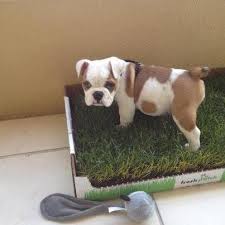
bulldog puppy with Fresh Patch

5) Go out to potty area with your dog. Every. Single. Time.
Far too many times this is where the potty training fails, completely.  This is the make or break rule right here (especially with puppies under 5 months!)  You must, must, must go out with your dog to be able to witness and praise when your dog goes where appropriate.  This is the key to teaching your dog where to go appropriately. Watch, wait, then praise. You can give a little treat after they have completed the "job" but you can also just use verbal praise for this.

6) Supervise like a helicopter mom (or dad!)
Don't let a puppy out of sight.  Stop a puppy during play (about 10-15 minutes in) and take out to go potty regardless of behavior.  Take puppy out upon waking from any amount of sleep, before leaving the house and before going to bed (even naptime).  This is especially critical for really small dogs (under 15 lbs) and/or puppies under 5 months of age.  If you cannot supervise a puppy (even for 10 minutes) put the puppy in the Safe Area or crate the puppy.

For adult dogs that need to learn to potty in an appropriate location, take them to the designated potty location every 30-60 minutes for the first few weeks of being in your home.  Gradually increase the time between potty breaks as they become more accustomed to it and/or show reliability.  Crate when not able to be supervised.  Follow the rules for a puppy with dogs as well -- Take dog out upon waking from any amount of sleep, before leaving the house and before going to bed (even naptime).

7) Be consistent. 
Every single person that interacts with your dog must be consistent with the potty habits you've started.  If someone cannot supervise a young puppy or maintain the routine you've put into place then be sure the puppy or dog is crated so that no accidents or setbacks can occur.

8) Setbacks might happen.  Medical issues might too.*
Be prepared for setbacks and accidents in the beginning.  Keep your cool. Just stick with it. If it's taking longer than you feel it should or your dog starts to have potty accidents out of character then always, always, always seek the help of a veterinarian to rule out a medical cause for potty problems.

This applies to puppies and dogs of all ages.  UTIs are not uncommon and can be an easy fix.  There are also other medical things that could be a reason for doggie potty problems.  Discuss with your vet and don't assume that a young puppy cannot have a medical cause or a middle-aged-already-potty-trained dog cannot have a medical cause.  Some have little to no symptoms other than potty issues.  So always err on the side of caution with that before jumping to behavioral conclusions.  If medical problems are totally cleared by a veterinarian then seek the advice of a professional for help.

TROUBLESHOOTING
If all else fails, you are losing your mind [or your sleep] then please contact a trainer near you.  Potty issues are often a cause for people to relinquish their pets to a shelter.  This is very disheartening given that potty problems are totally fixable. So, when all else fails call in the pros!  

Can't afford a pro? Then go back to the beginning.  Start small, keep a potty journal, remain consistent and don't allow time for error.

Happy potty training!  Oh and don't forget to go read my next blog post, "Crate Training Truths & Tips".
---
*It is always recommended that you clear your dog of any and all medical problems if you are having a heck of a time with potty training.  Ask your veterinarian for a urinalysis and/or sterile urine culture.  If needed maybe even blood work and/or an ultrasound of the bladder.  You and your vet can figure out the best plan of action to take. 

Stacy Greer
Sunshine Dog Training & Behavior, LLC

Tuesday, January 31, 2017

Attention Hog.

Is your dog an attention hog ... ok, an attention-seeker? Barks demandingly? Paws at you demandingly? Whines?  If so, you're not alone.  Even better news: It's totally fixable, curable actually (which means you can make it go away for good!)

Here is the first thing you should know about attention-seeking behaviors: they are learned behaviors. This means somewhere along the way someone has reinforced them and therefore they continue because they work for the dog.

So, this means the dog's behaviors can be fixed if you change your response to the behaviors.

DEFINING ATTENTION-SEEKING BEHAVIORS
Let's discuss defining what attention-seeking behaviors are and are not.  If a dog has a need that should be met -- needs to potty, hungry, etc. -- then the need should be addressed.  However, if the dog is just demanding one of those things but it's not a need at that moment then they are in fact using at attention-seeking behaviors to gain something they desire at that exact moment.

Puppies will be an exception in many of these situations.  Young puppies, under 5 months, are especially going to be more difficult to determine if they need to go potty or if they are just wanting attention, etc.  So you'll have to really get to know your puppy to know how to differentiate between needs that should be met or if the puppy is actually being demanding. When puppies are young I often give in to the behavior, whether it's a need or attention-seeking and address it later if it does become more of an attention-seeking behavior rather than a need. (More on this below)

HUNGRY OR DEMANDING FOOD?
As far as hunger goes, we have complete control of our dogs' meals and food (or we should, read: no free feeding!).  Therefore no dog should be demanding food, ever.  If they are it's an attention-seeking behavior not an actual need. (Note: If your dog does in fact act as if they are always hungry please have a vet check, including a full blood panel just to be safe.)

This also applies to puppies. All puppies should be fed on a schedule and when younger than 5 months should be fed 3-4 times a day.  This would definitely ensure that they aren't hungry throughout the day and shouldn't have a reason to demand food.  So, if your dog is medically sound there is no reason they should be demanding food; if they are then this is an attention-seeking behavior.

NEEDS TO POTTY OR DEMANDING TO GO OUT?
Needing to go potty is going to be the most common reason for a dog barking, whining, pawing or other behaviors that would be legitimate/may not fall into the attention-seeking category as easily.  Dogs will all use different behaviors to show they need to go potty.  The problem with this is the fine line between do they really need to potty or are they just demanding to go out or get your attention?

This is where it's important for you to know your dog and take several factors into account.  Did your dog potty 10 minutes prior? Did your dog drink water recently? Did your dog eat within an hour or so? Did your dog see a squirrel outside? Does your dog have a bit of diarrhea?  Does your dog know the neighbor's dog is out and want to go bark at him?

So, if you are certain your dog does not actually need to go out to relieve herself then she is likely just offering attention-seeking behaviors in the hopes that you'll let her out.

A SIDE EFFECT.
A little side effect, if you will, of dogs that get attention when they want is dogs that cannot learn to do nothing.  This really is an indirect form of attention-seeking: dogs that cannot do nothing.  When we have dogs we feel must always be engaged with us or doing something -- Oh he needs to be walked! Oh she needs to be jogged! Oh he needs to play! Oh she needs to be trained! -- then we create a dog that actually does need attention all the time or he'll drive you coo-coo-bananas. While those are all very important things to all dogs it becomes a problem when the dog is used to getting it all the time.  It can fall into the attention-seeking behavior category because they cannot just lie down and do nothing. They need attention in some form all the time.  Sadly, we create this. Giving into attention-seeking behaviors often snowballs into other things -- a dog that cannot just be ok with doing nothing and allowing you to watch TV or talk on the phone or read this blog! So, there are side effects to these types of behaviors as well.

I recommend all dogs like this should be taught how to relax on a mat. This is different than "go to your bed" or being told to go do something on cue.  This is actually teaching a dog to chill out, no their own. Nan Arthur, author of "Chill Out Fido" has a neat-o handout on this, click here.


OKAY ... SO, HOW DO I ADDRESS IT?!
Ok.  So now you're pretty sure you know how to define if your dog actually needs something or is demanding it (using an attention-seeking behavior to get what he wants).  The big question now is -- So how do I get my dog to stop being annoying?!

Quick answer:  Do nothing.
Explained: Do not look at your dog, do not talk to your dog, do not pet your dog, do not touch your dog, do not tell your dog to "go away", do not tell your dog to "go lay down", do not tell your dog to "sit" . . . you get the idea. Don't do anything, literally, do nothing. You might gently put your dog in his crate.  Not as a punishment but a way to get her away from you and to leave you alone, especially if you cannot ignore the dog. (No, this won't cause problems with associations with the crate.) In that moment your dog does not exist. You must ignore him completely.  While this is a very simple answer it's not an easy one.

It's not easy because ignoring a demanding dog is very difficult.  Most people have a very hard time doing this.  The dog is being annoying. Not, only this, if you do in fact start to ignore the dog the behavior will increase before it ceases completely.  These are the laws of psychology.  There is something called an extinction burst.  An extinction burst is a predictable and common blast of defiance from the recesses of a brain denied familiar rewards.  The brain makes a last ditch effort to return to it's old ways.  

So you're drudging along, ignoring like a champ, the dog finally stops quicker than normal and you feel like you're making great headway ... then suddenly the dog starts barking and scratching you.  Possibly even one of those behaviors isn't one that he did before.  You think -- forget this, it's not working! Look! Now he's scratching at me, he never did this before!  But alas, this actually is great news. This means your dog is trying hard to make that last attempt to break you.  A last attempt to get what he wants -- he's going through an extinction burst.  This means your efforts are working! Do not give up! Keep up the good work!

Here is a handy little chart you can use for a what to do and what not to do.
DOG’S ACTION/BEHAVIOR
WHAT YOU SHOULD DO
WHAT YOU SHOULD NOT DO
puts paw at/on you, our nudges you to elicit attention
if sitting, stand up, walk out of the room;
if standing turn & walk away
look at, pet, talk to or push the dog
whines or barks for attention/because he wants something or attention
if sitting, stand up, walk out of the room;
if standing turn & walk away
tell the dog to be quite, look at, pet or acknowledge the dog in any way
drops a toy at your feet or in your lap to elicit play or games
if sitting, stand up, walk out of the room;
if standing turn & walk away
look at, pet, talk to or push the dog
nips, mouths or grabs your hand/foot/clothing/shoes
put dog in crate, quietly & calmly  OR quickly get up & walk to the nearest room, close the door behind you, leave dog on other side of the door for 30 sec—1 min
pull away, push the dog away, yell, scream, look at, pet or acknowledge the dog in any way

TROUBLESHOOTING.
  • What happens when you do the above and the behavior is still strong or your dog starts a new annoying behavior in its place?
    • As stated above this often happens when things are in fact working and an extinction burst occurs. This indicates that your efforts are working and your dog is trying a last attempt to get what he wants.  You must remain strong, keep doing what you're doing, which should be a Professional Ignorer. 
  • What happens when I just cannot ignore the barking? It's incessant!!
    • I totally empathize with this. It's super hard to ignore a barking dog. It bothers me to no end, so I get it.  However if you cannot ignore the behavior then you'll have to face the reality that it will continue, plain and simple. 
  • I live in an apartment, so ignoring my dog that is barking is going to be hard.  Any creative ideas?
    • This does present a problem as neighbors may not be too keen to suffer through your new training regime.  
    • If your dog does barking only for attention but not if you leave then I'd use the front door as my escape.  Dog barks for attention -- walk out of the door.  If your dog is crate trained and is quiet in the crate then gently put dog in crate as soon as she starts barking.  Cover crate if you have to, with a sheet or blanket.
If none of the above seems to work for you, it's going to be hugely beneficial that you find a trainer near you to come in and help you.  Usually attention-seeking behaviors come with a few other things that could be tweaked to benefit the dog long term.  

Happy training from your favorite red-headed dog trainer in Texas. 

Stacy Greer
Sunshine Dog Training & Behavior, LLC

Friday, January 20, 2017

We tried that. It didn't work.

 Nelson is a 4 years old Goldendoodle. He runs off when the door opens. He doesn't come back when he's called. He often doesn't respond when asked to do things.  Does Nelson sound like a dog you know?

Nelson's case is a common call I get as a professional dog trainer.  He's been practicing unwanted behaviors his whole life.  The owner is at wits end and has decided to find a professional to help.  Great!  I love these cases because once they start training the dog often responds quickly and does very well.  

However, the downside to these cases is that the owner is at their wit's end and they are tired.  
I get that. It's frustrating to have a dog that seems to be a pain to live with.  Sometimes a spouse/partner is tired of the dog and it is a source of tension in the relationship.  This causes even more stress. I do empathize.

So by the time I get the call the owner is really ready for results.  What they don't often grasp is the fact that the dog has had a long time, often months or years, to practice poor behaviors.  This is called the Matching Law.  So if your dog has barked at every stranger that walks in your door for 6 months it will take some time of the dog not barking at strangers that walk in the door before the behavior is extinguished . . . and that's not all of it . . . you have to find a desired behavior that receives [positive] reinforcement and rewards to replace the barking behavior.  
With all this said, my point: there is no quick fix.

This is why training your dog several times a week, consistently, is important.  It is also important to implement your trainer's advice as they lay it out for you.  Once a week training only when your trainer is there or if you are in a class isn't going to get you the desired results you had in mind.

This is also when I hear a lot of "Oh we tried that, it didn't work", or "We tried Suzie Q Trainer and she didn't help us."  While this can be true sometimes, most of the time this means the owner didn't see immediate results, didn't practice or carry out training as they should have, or all of the above.  

I tell all my clients -- you don't need hours a day to work with your dog, you can achieve success with 5-10 minute training sessions daily or every few days, a couple times a day. That's it.  I also explain how owners can incorporate training into daily life.  If you are washing the dishes at the sink you can easily practice your dog's "get on your mat" cue, or durations [staying for longer periods of time], or  stay-out-of-the-kitchen-and-wait-on-your-bed-in-the-living-room-until-I-tell-you  -- the possibilities are vast.

Anyone can train their dog.  A trainer is highly recommended for much needed guidance.  Just plan accordingly and keep your expectations realistic for your dog and your trainer.  

If you try something and it "doesn't work" ask your trainer.  I like to tell people nowadays to video themselves working on what they are struggling with and let me view it to offer help.  This can be a great way for you to watch yourself and catch your own mistakes (secret revealed: I find mistakes in my videos of myself all the time!) or your trainer to catch something you didn't see.  

So don't be discouraged. Find a trainer that you mesh with, you believe in what they are teaching, how they are teaching it and helping you as you hoped they would.  

In the Dallas/Ft Worth, Texas metroplex? Look me up! 
Stacy Greer

Monday, August 1, 2016

"Oh, you're a dog trainer? That must be so fun!"

As most of my blog posts are, this one was inspired by a few things this past weekend after I attended a conference for dog trainers.  The first spark in my brain was fired off when I was talking to a client before I left town and said to her, "I'll call you when I get back in town, I'm leaving for a dog trainers' conference this weekend..." to which she responded by laughing and saying "A dog trainers' conference?! [insert laughter]"  I really wasn't what I'd call "offended" but it did hit a chord with me that my profession is often regarded as a fun job and one that cannot be all that serious.  I mean after all we do work with fun, fuzzy dogs, right ... how serious can it be?!
So I want to tell you lovely people of the world about dog trainers.  This is how we work. This is what we do. This is how we do it. Every day. I'm fairly certain I speak on behalf of many, if not all, dog trainers that do this as a full-time job (and even those that do it part-time!).

We care about you. 
We care about your dogs. This is why we do it.
We move our schedules around to accommodate for our lesson with you.
We read your info, we take notes and we plan on how to help.
We drive however far we plan to in order to get to you.
We work with you to the best of our ability, attempting for more than that.
We go home and think about you, about your dog.
We lay in bed at night and think "Oh man! I should have told her this!" "Oh my gosh! What about that?!"
We rub shampoo in our hair the next day while we shower and we think "Oh no, what if she didn't like that advice?!" "I totally need to email her and tell her to do this!"

If we get an email or phone call from an upset client we ramble in our brains how to help. 
We toss and turn at night trying to pin-point what went wrong.  How could we have done better?
We rush home from lunch to find a time to get back to that email or follow up on that phone call.
We thrash around things in our brains "Oh no! Fluffy I was sure was doing great. What happened? What did I do wrong? Oh I forgot that piece of advice to give! Crap! I didn't shoot that handout off to her!"
We brain storm more. We stuff that sandwich in our mouth. We re-heat the coffee cup (for the 3rd time).
We look in our brains for ways to give better help, better advice.
We look for an open spot in our schedule to get to your house quickly. 
We lay in bed that night, again, and hope that day's advice is helpful. 
We wonder if things are working out as planned.
We wonder if you'll leave a good review on Yelp or Facebook or tell your vet about us.
We wonder if you'll write a nasty email because we weren't good enough.
We wonder if you'll follow through and email us if you are struggling.
We smile at the success-in-progress emails you send us! (These are our favorites!)
We hope to receive emails with questions, if you have any. (We love these too!)
We cry when we receive the hard emails, the hard cases.
We cry when you cry. 
We cry when we can't help. (We cry a lot!)
We cry when you are unsatisfied.
We cry more when we get nasty emails.
We feel like failures, sometimes more than we should.

We love your dogs.
We look at our schedule and smile "Oh! I get to see Fluffy today!"
We like margaritas. (Ok at least I do!)
We like to laugh.
We like to make you laugh.
We love how much you love your dog.
We love that you called us!
We love that you want what is best for Fido.
We want what is best for Fido too!
We love the work you put in, and we put in, and Fido puts in, every single day.
We love the product of everyone's work!

We wake up. We do it again. And again. And again.

We go through everything you do whether your job is a mother, a painter, a lawyer, a doctor, a plumber, an engineer, an artist, a teacher, a therapist, a truck driver ... Our job is full of difficulties and successes, just like yours is.  It's full of joy and happy endings.  It's full of tears and sad endings sometimes too.  It may be full of more slobbers and hair than yours is but it's still just like your job in so many ways.

This is a dog trainer.  .... I wouldn't have it any other way!

Saturday, April 2, 2016

My dog won't stop jumping on people! Help! (Part III)

DOGS THAT JUMP ON PEOPLE.
This is a 3-part blog series. This is Part III of III.
If you missed Part I and Part II it is recommended that you go back and read them first.  They have important information for you to follow in order to have these training plans be successful.  You can find Part I here and Part II here.

In Part I we discussed why dogs jump on people.  Now that we've discussed that we can move onto the beginning stages to get your dog to choose to do a more appropriate behavior when greeting people, rather than jumping.  In Part II we discuss the protocols you need to have in place and implement before starting the actual training process.  This is very important to do, if you do not do the protocols prior to training the training will not be successful. So be sure you've read Part I and Part II before continuing with this post, Part III.

FOR YOUNG PUPPIES THAT JUMP
If you have a puppy it's very easy to stop this behavior from growing into a real problem. I'd say this would apply if your puppy is under (4 months) 16 weeks of age. If your puppy is older than 4 months it may be a little more difficult only because the behavior has been reinforced for a while. Although it would still be easy with a young dog to work on this because they have not had months or years of reinforcement.  Working on this with puppies is a must in my book and is so very easy to do and will prevent a habit from ever forming.

So, if you have a puppy start by never ever touching your puppy or talking to him when he's jumping. Never. Read that again. This is easy to read and understand but it's often not in the front of our brains when in fact a darling little 10 week old puppy is jumping on us to say "hi". If you touch, talk to or look at a dog you could be reinforcing behavior. Instead when a puppy approaches you immediately stop petting the puppy if it starts to jump. Toss treats behind the puppy and reward the pup in any way that reinforces it for being on the floor and not jumping.

Reinforce the heck outta "sit". If a puppy sits you better be ready to reward it. Teach the puppy sit = happy and wonderful things, especially when the puppy sits before greeting or upon greeting someone.

You do the above with puppies and you'll be well on your way to a dog that doesn't jump on people!

Emily Larlham of Dogmantics Dog Training and kikopup YouTube channel has a great video on this as well. You can find that here.

FOR OVER-EXCITED GREETERS
If your dog just cannot contain her joy at the thought of a new person coming to greet her and seemingly loses her ever lovin' mind .... um, you've got your work cut out for you! ha! But no really, don't be too worried. You can do this, it's just going to be critical to follow the protocols in Part II to get this type of dog ready to meet people without making a scene.

First, implement protocol #4 from Part II, which is start training in a sterile environment when guests aren't around. The first thing this dog needs to learn is how to relax. I find when I talk about this people think this sounds crazy. "Exactly how is this going to help my dog learn to greet others without jumping?!" Well because these dogs are usually wound up pretty tight and even if the dog isn't jumping on those people that live with her the dog has an internal issue with relaxation, as in, it's not really all that great unless the dog is tired. Sometimes these dogs need to be super tired, sometimes just a little bit. Either way these types of jumpers need to learn to relax and by "learn" I mean it needs to be taught.

Teaching a dog to relax on a mat is not the same as telling a dog to go lie on a bed and "stay". That's not relaxing that's a dog being told what to do and for how long. Relaxing is just that, relaxing. Think of yourself on a lovely vacation where you can soak up the sun and sip a Mai Tai or cup of joe while thinking about the ocean waves around you. That's relaxed. No one is telling you what to do or how to do it or for how long. You are just out there chillin'. Your dog needs to learn to do that. You can follow this step-by-step how-to here to learn to do this. I also highly recommend Nan Arthur's book "Chill Out Fido" (who wrote the relax on a mat how-to I just referenced.) As you'll notice from the linked handout, this is an exercise you'll do daily with this dog for quite some time depending on the dog.

I would focus heavily on the relax on a mat exercises and also start this dog with training "sit" for just about anything she wants. Doing this will help her learn an automatic "sit for everything I want to get" and it will help when you want to transfer that to "oh and this also means sit for greeting others too."

Before starting I want to make note that I am assuming your dog has been taught to "sit" by being asked to do so.  They understand it to some degree even if not completely reliable.  If your dog doesn't do this, here is a great video on how to start.  If you aren't using a clicker for training you can substitute the clicker (or click) with a verbal "Yes!" followed by a treat.
(Here is an awesome video on "What is clicker training?" and also one on "How to train without a clicker")

However, with this process I like to wait for the dog to offer a sit without verbally prompting the dog to do so (again, if your dog needs help with this do it like it is done in the video linked in the previous paragraph.)  So we aren't actually teaching her to sit on [verbal] cue but rather that when the dog offers a sit as a behavior she will get what she wants.  This will create a dog that sits prior to getting something on her own.  If you verbally ask her to sit she may learn to wait to be told to sit before actually doing it.  We want her to choose to sit on her own.  You can do this by just standing there, tall (don't bend over the dog) and waiting for the dog to sit on her own.  Hold back from asking her to sit, don't say anything to her just wait for her to sit.  After she sits reward her.

I would play some games with your dog (and have everyone in the home do the same) like the following:  Have your dog sit directly in front of you, again by waiting for her to sit on her own (no verbal prompting).  You could start this by calling her over and waiting for her to sit in front of you.  Once she does, dole out 5-6 small pieces of yummy treats. Let her walk away or you walk away. Then a few minutes later do it again. Repeat this 4 times. Just simply having the dog come sit in front of you and rewarding profusely. Be sure you are verbally telling her she's good as well as handing out lots of treats after she sits. Again, have everyone in the home do this as well. Soon she'll be coming to sit in front of you on her own, and when she does you better give her whatever it is that may be rewarding to her in that moment -- yummy treats, toss a ball, hand her treats, give her dinner, pet behind her ears, whatever she likes she gets for sitting in front of you.

After she's gotten pretty good with that. Invite a friend over. If possible invite a friend that the dog has the least excited reaction to (if this is possible, some dogs react the same to everyone, some have favorites.) Prep friend for this training session, as they are about to help you with your dog's greeting skills. Put your dog away prior to the friend coming over. Have friend armed with high value treats, at least 30-40 very small ones.

Let dog into the room. As soon as your friend sees the dog have said friend toss treats away from his body (the friend's) and aiming for behind the dog or at least a distance away from the friend. The dog should stop and turn around to get the treats. When dog looks up, almost headed to greet, friend repeats tossing treats. Friend should repeat this at least 4-5 times. During all this friend needs to be standing tall (not stooping or bending over) and not speaking to the dog at all. The friend will simply toss treats behind the dog.

After about the 5th time friend has tossed treats away from himself then see what dog does. If friend is quiet and calm dog should come up to friend and sit in front of him. If she doesn't friend stands tall, doesn't engage with the dog in any way and waits. If/when dog sits, dog gets treats. Friend should remain quiet and calm throughout visit in the home. This will help immensely, especially with an over-excited greeter. After this small training session the dog should be put away to relax or if the dog is now relaxed the dog can stay out or go lie and relax on her mat.

Repeat the above exercise with same friend until dog becomes relaxed in greetings with this friend. Then add next friend, then next friend (or aunt or uncle or whatever) and so on. The dog should soon begin to generalize how to greet people in the home regardless of who it is.

It is imperative during the process that an excited greeter never gets reinforced for excited greetings. Never touch the dog (even to push the dog away!), never talk to the dog (even to say "get down!"), and do not look at the dog (turn head away or look up when dog is excited). It should be noted that if you only use these things (ignoring the dog and turning away when jumping) as your training plan it won't work.  These things alone will usually create a dog that is confused and becomes more jumpy and frustrated. So ignoring a jumping dog and waiting for the dog to just stop jumping because it realizes the jumping isn't working is not successful as a training plan. Ask me how I know this. I used to use this as the first line of defense to start to teach a dog not to jump. If you were a client of mine back in the day you likely recall me telling you this advice. However, now that I know better I do better. So, while these things should be practiced (ignoring the dog if she jumps) while training the other things (the training plan above), they must all be utilized together to actually work.

However, you must note that if you don't do the exercises above and allow the dog to become over excited and rush up to greet someone you will be setting your dog up to fail.  This is not implementing protocols in Part II, which should always be implemented.

TROUBLESHOOTING
If you have a highly excitable, over-aroused dog and you are having difficulty with working on this it could be due to a few things.
  • Are you becoming frustrated and discouraged?  If so, take a step back.  Start with the relaxation exercises. Be sure you are doing these for a few weeks prior to starting the work with guests. Also, never work with a dog while frustrated, especially an over-aroused dog as this will feed the arousal and the vicious cycle will drive you mad!
  • Are you setting your dog up for success?  If you are still in the early phase of the process the dog should never be allowed to greet guests, should be crated, in another room or put away so that they cannot become over-aroused/excited and practice this behavior.
  • Are you jumping the gun?  Is your dog ready to start these training protocols?  Have you skipped a few steps?  If yes, then be sure you haven't!  Start and go slow. It's not going to show up like magic!
I really love the following article by Laura VanArendonk Baugh, CPDT, KPACTP of Canines In Action, Inc. in Indianapolis, Indiana on how to teach proper greetings. It is broken down into very small pieces (which is great for success) and does include steps I didn't mention, but dog training has a lot of solutions, not just one! She also has an excellent book called "Fired Up, Frantic and Freaked Out".

NOTE: As you can gather, the above training program would be much more helpful if coached by a trained professional, in person. This is also not covering some other "types" of jumpers. I addressed the over-excited ones because that's the most common.
While you can do the above on your own it would be much more successful with professional guidance.  If at any point you find yourself saying "I read this blog and followed it and it didn't work"... that's because a trainer would be a better option to help you so that you can have guidance every step of the way.

# # #

Stacy Greer of Stacy's Dog Training has trained dogs professionally in the Dallas/Ft Worth Texas metroplex for 16 years. www.stacysdogtraining.com

Thursday, March 17, 2016

My dog won't stop jumping on people! Help! (Part II)

DOGS THAT JUMP ON PEOPLE.
This is a 3-part blog series. This is Part II of III.
If you missed Part I it is recommended that you go back and read it first.  You can find Part I here.
In Part I we discussed why dogs jump on people.  Now that we've discussed that we can move onto the beginning stages to get your dog to choose to do a more appropriate behavior when greeting people, rather than jumping.

HOW DO YOU IMPLEMENT THE PROTOCOL(S)?
I will first say that I do suggest you hire a dog training professional to help you with this, as I do with pretty much all behaviors, because they will be able to help you through the entire process. With that said, this is the internet and we all want the answers for free, quickly and right now! I understand this but I am going to stress this again -- a trainer will be able to help you and your dog and his/her specific jumping problems (or any others that s/he may have) better than reading a blog.  Ok now that is out of the way I'll give you some basic tips that you can implement yourself. For free. On the internet. Enjoy! (If you get confused please contact a trainer near you.)

1) Stop reinforcing the jumping ... and even more importantly, stop everyone else who comes in contact with your dog from reinforcing the jumping. This is the most difficult part of getting rid of jumping because you have to really be advocating for your dog's training and not allow others to reinforce the jumping. It will be the #1 reason your dog will continue to jump on others, even if/when he stops jumping on those in the home.

2) Set a plan and type it out. Share with all the world to see. Somewhat piggybacking off of the first one, but this is important. Consistency across the board. Come up with a plan of what you will be doing so that everyone in the family can see it and understand what their role is with the dog. Go over it. Discuss it. Show everyone how to do it.

3) Set the dog up to succeed. Example: If you know that your dog jumps on every guest that enters your home then don't allow your dog to be free and able to go to the door to do this when someone comes to your door until you are ready to move to this part of the training protocol. Put the dog away.  I don't care where. In a crate. In the backyard. In a bedroom. In the laundry room. Wherever the dog can be that prevents it from being able to go to the door and practice the dog's poor behaviors. This only occurs until the dog's training is advanced to the level of having friends come over to be part of this portion of the training.

4) Train the dog when guests aren't around. This somewhat goes along with #3 because it will set your dog up to be trained from a very low distraction stage to an increasingly higher distraction stage.  This is vital to training your dog in any area. You cannot expect your dog to start learning not to jump on guests during Thanksgiving holidays when you have 7 family members coming in and out of the home. It's all about slowly working your way up to the major distractions by succeeding in all the lower distractions first.

OK, BUT WHAT DO I DO TO ACTUALLY STOP THE JUMPING?!
Now that your first goals are set you can get some tips on what to do that involves the dog and teaching him/her what you want him/her to do instead of jumping.
In Part III of this blog series we will layout a few different techniques you can use to get your dog to stop jumping on people.  So head on over there and read the tips in Part III.
# # #

Stacy Greer of Stacy's Dog Training has trained dogs professionally in the Dallas/Ft Worth Texas metroplex for 16 years. www.stacysdogtraining.com

My dog won't stop jumping on people! Help! (Part I)

DOGS THAT JUMP ON PEOPLE.
This is a 3-part blog series. This is Part I of III.
One of the absolute biggest complaints from dog owners and questions I get as a trainer is -- How can I get my dog to stop jumping on people?!

First there isn't a single, simple or quick answer to this. This is a multi-faceted answer because there are so many factors when it comes to jumping. Pretty much most dog training doesn't have a simple and/or single answer .... but anyway ...  We must first identify the reason and/or cause of the jumping.  There are several reasons a dog may jump and once we identify this we can move forward.

WHAT DO YOU WANT?
The first step is to ask yourself this -- What do you want your dog to do? Before you answer that make sure the answer doesn't include "I want him to stop/not/quit jumping!" I know what you don't like I want to know what you do in fact want your dog to do when s/he sees and/or greets other people.

It would be awesome if I had a simple answer.  If only I could say "do XYZ and it will stop your dog from jumping."  However, it's not quite that simple. Yes, you could find some punishment-style "methods" that correct a dog when it jumps however this doesn't get to the root of the problem. Punishing a dog for jumping often makes the dog stop temporarily in the moment or just stops the dog from jumping on whomever is giving the corrections.  In the end this means the dog hasn't  learned not to jump just to avoid corrections or those giving corrections. Punishments rarely work and rarely teach anything to the dog, if ever.  My goal is to teach a dog a better solution to jumping and to have the dog choose not to jump and eliminate the jumping.

WHAT ARE THE OPTIONS?
So there are a few things you can do to begin your process of training.  Set a goal. The very best course of action is to set a goal of Fido being relaxed and able to greet with little to no arousal and then we can set the goal of an alternate behavior to happen when people come into the home such as lying on a mat or sitting for greetings.

WHY DO DOGS JUMP ANYWAY?!
I find it funny because you can Google away and find many explanations for a dog that jumps. Some dogs just jump. But the most common reason, and one that applies to the majority of jumpers, is that they have been reinforced in some way and so it creates a behavior, albeit an unwanted one.

Many dogs also jump because they are in a state of over-arousal and cannot calm themselves down, they get over-aroused when a new person is there and the cycle begins. Jumping is alternately rewarded in a very unintentional way (person pushes dog, tells dog to stop/get down, etc.) and the jumping becomes even more obnoxious.  This often intertwines with the first one, meaning that this happens and then is unknowingly reinforced and the cycle continues.

I've also seen in my years of training dogs and understanding their behavior that some dogs that are very stressed and/or anxious will jump out of nervousness, almost like a small child that wants mommy to hold him when he's uneasy. This type of jumping requires a totally different protocol as it's not really a jumping issue but a confidence issue.  If you think this applies to your dog I do recommend that you find a qualified trainer to help you.  This isn't a true jumping issue as the root of it is deeper than that, therefore this will not be discussed in this blog post.  If you are unsure if this applies to your dog contact me and I'll be glad to help (take a video of your dog jumping and send it to me for a better assessment.)

Now that you might have a better understanding to why your dog jumps let's discuss how to start a protocol to get the jumping under control and a better behavior pattern for greeting people for your dog!  Head on over to Part II for this info.
# # #

Stacy Greer of Stacy's Dog Training has trained dogs professionally in the Dallas/Ft Worth Texas metroplex for 16 years. www.stacysdogtraining.com